Principles of Supervised AI Administration: Preventing SaaS Configuration Debt
With AI all over the place, it’s so easy now to ask an agent how to configure a system. How quick and simple was your experience when you opened ChatGPT or Claude, typed a quick question about a broken workflow transition, permission error, or custom field condition, and got a working answer in five seconds?
It feels like magic. You copy the JQL, adjust the validator, or adjust the screen scheme and the issue is fixed.
That five-second fix is just another small step toward an administrative nightmare and debt.
Ask any LLM how field contexts resolve in enterprise platforms like Atlassian Jira Cloud, Salesforce Service Cloud, Monday.com, or ServiceNow, how to refine a query to match a date range, or why a specific transition is blocked. Assuming you provided sufficient context in your question, it instantly delivers a technically accurate answer, reading documentation from the web. Atlassian’s public documentation, for example, is vast, mature, and thoroughly indexed. Generic models have read all of it.
The mistake enterprise leadership makes is assuming a correct technical explanation doubles as a safe operational instruction for their production environment.
General AI can answer questions technically, but it will always miss two critical contexts required to design, scale, or optimize your operational tooling:
- how your proprietary SaaS instance is currently constructed
- the unwritten operational dynamics of your business.
Without both inputs, relying on AI-generated configurations produces a subtle, compounding failure mode: Tool Configuration Drift.
Key takeaways
- Your configuration is your codebase, with one difference that decides everything: no compiler flags a bad configuration choice, so the error surfaces as other teams losing time.
- A general model returns a syntactically valid answer for a clean, out-of-the-box environment. Applied to a mature instance that answer is near-right, which is not the same as right.
- Near-right changes compound. A local fix edits a shared scheme, the teams that inherit it work around the result, and after twelve months nobody can explain the dependencies.
- Reading your technical configuration tells a model what is configured. It says nothing about why, which is why a structured record of business requirements is the missing input.
- Supervised AI administration is four rules: baseline before writing, compile a legible plan, keep business decisions human, and make every change auditable and reversible.
1. The Hidden Cost of Enterprise SaaS Configuration Debt
Before diving into how AI advice can derail production systems, executives must recognize a fundamental reality of modern enterprise tech stacks: your configuration is your codebase.
When software engineers write code, compilers, analysis tools, and automated CI/CD pipelines flag structural flaws before they reach production. But when an administrator or business user modifies a low-code platform like Jira, Salesforce, or ServiceNow, no compiler throws an error. The safety net becomes your product, dev and marketing teams, who must compensate for a non optimal configuration, at worst bringing their work to a halt.
This unmanaged setup complexity isn’t just an administrative annoyance. It is a formally recognized system failure. Leading software engineering research confirms that configuration choices are just as toxic to enterprise velocity as bad source code:
- Carnegie Mellon’s Software Engineering Institute (SEI): In their analysis on organizational technical debt, SEI explicitly categorizes Enterprise Technical Debt: "Like all technical debt, enterprise technical debt consists of choices expedient in the short term, but often problematic over the long term... When viewed from the enterprise perspective, however, the security and maintenance risks were clear." Setup choices such as brittle integration paths, duplicated permission matrices, and inconsistent role definitions rarely break a single project immediately, but create massive long-term risks across the enterprise.
- Forrester’s AI & Governance Research: Forrester highlights the hidden debt generated by automated and low-code build tools: "The speed is real, but so is the debt: Code that no one wrote by hand is code that no one fully understands, and maintaining what you don’t understand is a cost." Because SaaS platforms allow rapid point-and-point edits without code reviews or testing guardrails, unmanaged configurations rapidly degrade software quality.
- Gartner’s LCAP & Modernization Benchmarks: In their strategic research on low-code platforms, Gartner emphasizes: "Software engineering leaders must proactively manage technical debt within Low-Code Application Platforms (LCAP) to prevent costly rework and maintain system reliability." Gartner research reveals that 71% of IT leaders cite application modernization and legacy debt as their primary operational bottleneck.
- The Stripe Developer Coefficient: In their global survey of developers and C-level executives, Stripe quantifies the productivity tax of technical maintenance: "Engineers spend an average of 17.3 hours per week on maintenance and bad code... Of those 17.3 hours, about 13.5 go to technical debt specifically, roughly a third (33%) of total engineering capacity." Poor platform configuration choices directly steal engineering capacity away from high-value innovation.
- The McKinsey Tech Debt Benchmark: McKinsey’s enterprise tech debt research reveals that CIOs report technical debt accounts for "20% to 40% of their entire technology estate’s value before depreciation." The ongoing productivity tax causes a 25% to 50% drop in feature delivery velocity over time for high-debt organizations compared to their competitors.
2. How "Near-Right" Configurations Compound into Systemic Debt
When you ask a general LLM for help with a platform setup, it provides a syntactically valid answer for a clean, out-of-the-box environment. However, applying a generic answer to an existing enterprise instance introduces a "near-right" miss.
When the change solves the immediate problem without crashing a workflow, it creates Immediate Success Bias. It may seem that the change provides a correct solution that supports all stakeholders, but this is actually a high-interest loan on your platform’s future stability.
The compounding debt mechanism begins immediately beneath the surface:
- Local Fix Applied: Admin asks AI to solve Team A’s issue. AI gives a generic, syntactically correct fix.
- Silent Shared Configuration Contagion: The fix alters a shared Workflow Scheme or Field Configuration inherited by Teams B, C, and D.
- Stacking Micro-Workarounds: Team B experiences new validation errors. They ask AI for another quick fix, layering workaround #2 on top of workaround #1.
- Architectural Drift & Systemic Latency: After 12 months of near-right changes, simple platform updates require weeks of auditing because nobody understands the underlying dependencies.
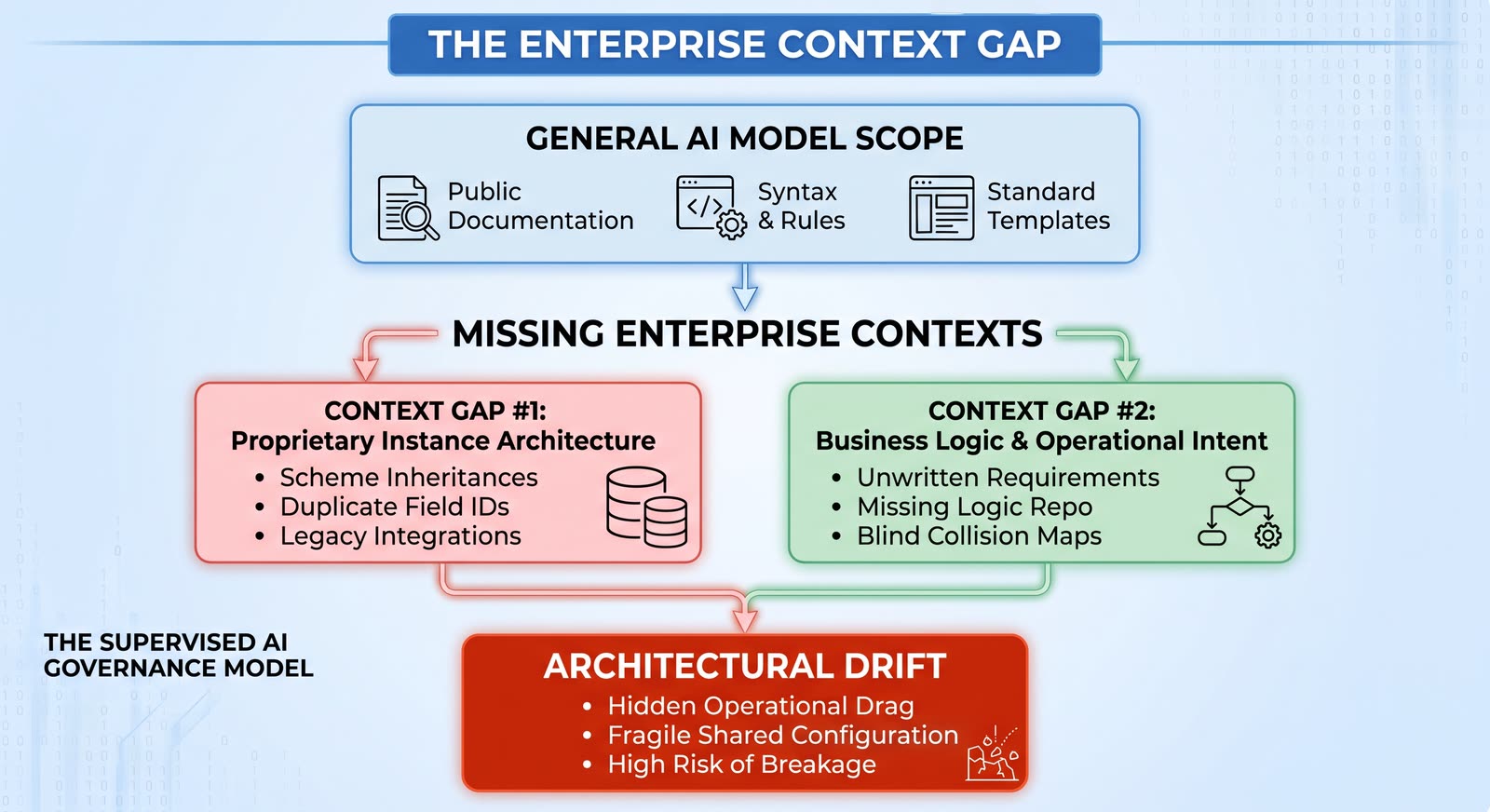
3. Context Gap #1: Your Proprietary Platform Architecture
Generic LLMs operate blind to your enterprise software, a complete carte blanche for them. Still, no company operating for over a year has a clean Jira or Monday.com instance without internal dependencies between its system elements.
Your instance contains organizational and business history: decisions made under constraints that were rarely documented in the system itself. These are not part of what the LLM knows.
A. The Shared Configuration Problem
Platforms like Jira and Salesforce rely heavily on shared configuration schemes (Workflow Schemes, Permission Schemes, Field Schemes, and Screen Schemes). A change requested by Team A to streamline their board often requires modifying a shared scheme inherited by other teams. Generic AI models evaluating a prompt like "How do I make the Security Impact field required on bug submissions?" will direct you to adjust the field or screen behaviors, without challenging the request. An LLM response cannot know that the change will break automated intake forms for three other engineering teams sharing that configuration.
B. Duplicate Field Polling & Identifier Ambiguity
In mature instances, it is common to find three or four custom fields with identical display names or business goals (Target Date, Due Date, Planned Date). When you ask an LLM to add a "Due Date" field, it doesn’t account for whether the team actually needed "Target Date". Without visibility into existing custom fields, display-name matching fails. Applying an AI-generated rule based on display names alone can silently update or query the wrong field, leaving requirements mismanaged.
C. Undocumented Downstream Dependencies
A seemingly redundant mandatory field in a project might be feeding an automated ETL pipeline that populates quarterly financial compliance reports. When an administrator follows a model’s instructions on how to remove that field as one team finds it a nuisance, they silently break downstream compliance reporting.
4. Micro-Scenarios: What You Asked vs. What the Platform Did
To understand how generic AI recommendations collapse in production, consider these real-world micro-scenarios:
Scenario A: Workflow Transition
- What You Asked for:
- "How do I auto-close linked sub-tasks when a parent is Done?"
- What Generic AI Recommended:
- Recommended an automation rule matching on issue type "Sub-task" and parent state "Done".
- The Production Reality:
- Silently broke QA testing boards because QA uses a custom sub-task issue type ("QA Test") that was excluded by the rule, leaving tests unassigned.
Scenario B: Custom Field Cleanup
- What You Asked for:
- "How can I hide the 'Cost Center' field for projects that don’t use it?"
- What Generic AI Recommended:
- Recommended modifying the Field Configuration to set the field to Hidden.
- The Production Reality:
- Instantly hid the field for Finance and Legal operations projects sharing that global configuration, breaking their monthly audit reporting.
Scenario C: Access Permissions
- What You Asked for:
- "How do I grant vendor contractors access to view tickets in Project ALPHA?"
- What Generic AI Recommended:
- Recommended updating the Permission Scheme to grant project access to the global group jira-contractors.
- The Production Reality:
- Granted external contractors access to three other confidential projects that shared the exact same global Permission Scheme.
5. Context Gap #2: The Missing Requirement Repository & Collision Mapping
The deeper, more critical challenge is that general AI has never met your organization and has mostly no access to your business flows.
Reading technical configuration data (Context Gap #1) tells an AI what is configured, but it reveals nothing about why it was configured or what operational requirements it serves.
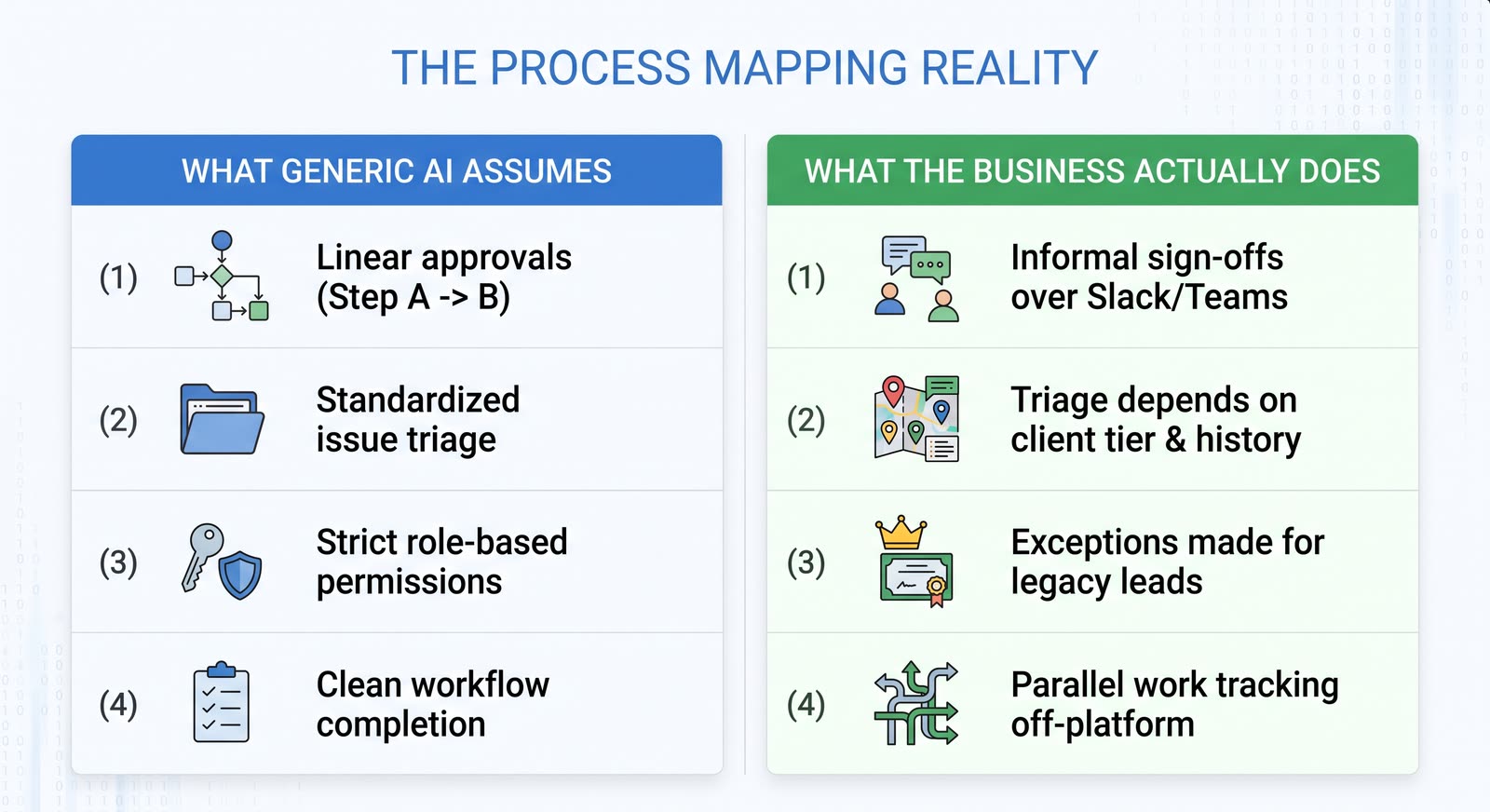
The Case For Documenting Business Requirements
In traditional software development, logic is documented in spec files, user stories, and acceptance criteria. In enterprise platforms, business rules frequently exist only as implicit settings or unwritten operational habits.
To safely govern AI administrative recommendations, enterprise platforms require a structured Requirement Repository, a centralized mapping of business logic rules, regulatory mandates, and operational dependencies.
Predicting Unforeseen Collisions
When an AI model has access to both technical site architecture and a Business Logic Repository, its role fundamentally transforms from a generic answer bot to an active Collision Detection Engine:
- Cross-Departmental Impact: When an admin asks to simplify a transition status, the AI cross-references the logic repository and warns: "Removing this status satisfies Team A’s request, but affects Teams B, C, and D. Here is how we can address the conflict..."
- Business Logic Validation: Instead of applying blind edits, the AI maps potential downstream collisions, notifying admins: "Modifying this custom field context will impact 3 downstream integrations and 2 executive reports."
Without a structured business logic layer, AI will continue to draft workflows that force the configuration to drift rather than align software with operational reality.
6. Case Study: The Cost of Unguided AI Automation
The following anonymized enterprise case study illustrates how unguided AI recommendations create hidden operational vulnerabilities.
The Context
An audit service firm operated multiple Jira Service Management (JSM) projects alongside Jira Software. To accelerate delivery, they wanted to streamline issue syncing between JSM and the Dev software project. An LLM suggested a script that, based on a flag, copies and links issues between the projects. Technically, a sound solution.
The Misalignment
In their conversation with the LLM, they pushed strongly toward a quick solution and described it as being urgently needed. This led to an agent’s drift where it suggested setting the flag to default = true and letting the users remove that flag manually. This resulted in many tickets overloading the dev side, even though most of them never needed to reach dev.
Another problem was a conflict with regulatory requirements. On the JSM side, a mechanism was implemented to ensure that only non-conflict users had access in order to aid an audit, a regulatory business requirement. On the dev side, restricted access was never implemented, and access was granted to users who were not permitted. This could have been resolved by reducing data transferred between projects or identifying and implementing a permission mechanism on the dev side.
Without a Business Logic Repository to flag restrictions, the LLM will choose between one of any possible solutions that answers your questions, not knowing which is the right one or why.
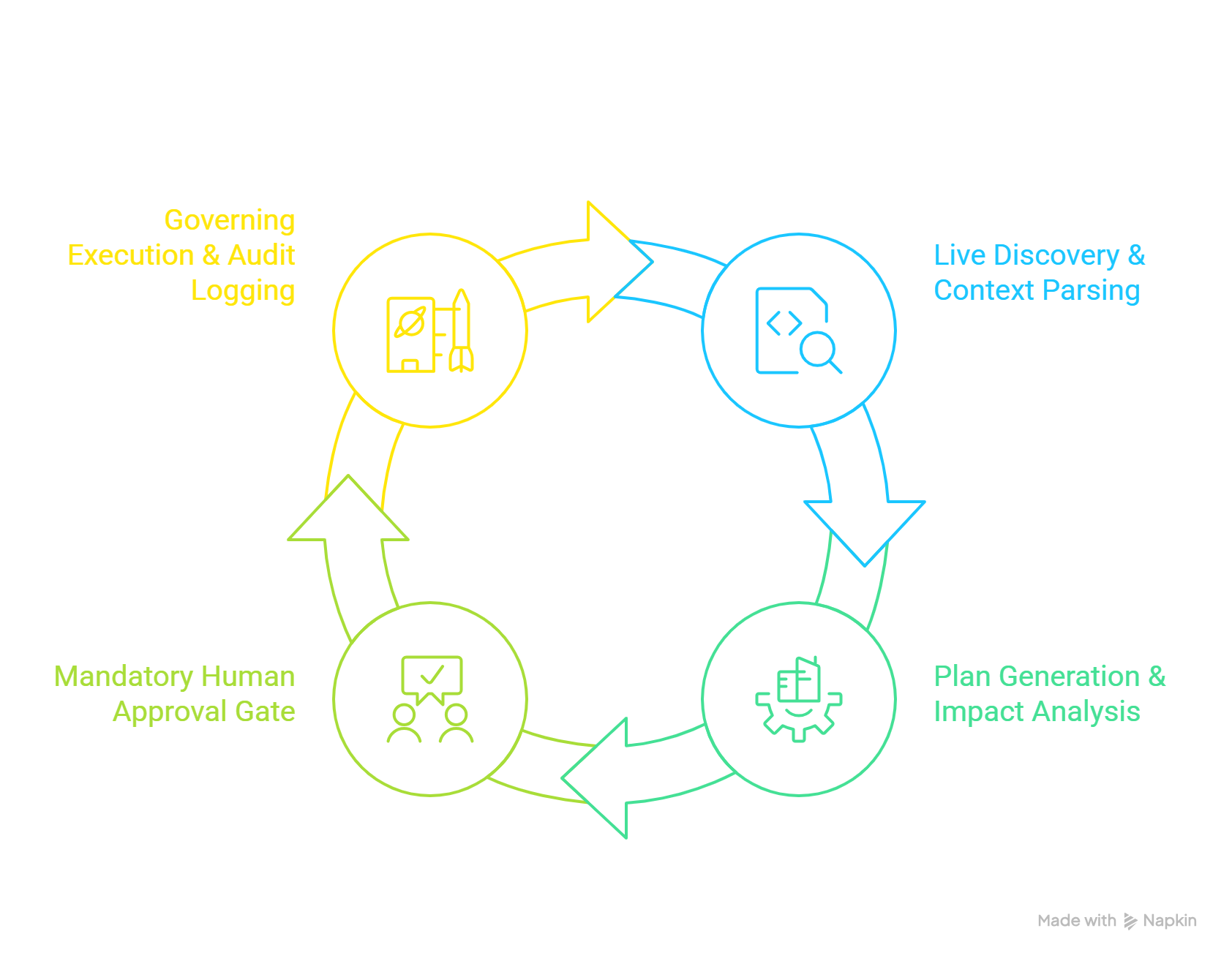
7. The 4 Principles of Supervised AI Administration
To prevent configuration drift while benefiting from AI robustness, enterprise platforms must adopt Supervised AI Administration, built upon 4 core principles:
Principle 1: Read-Before-Write Baselining
- The Rule:
- No automated tool or administrator may apply configuration changes without first programmatically parsing the live site’s dependency tree (both technical and business logic based).
- Why It Matters:
- You cannot evaluate the impact of a change without knowing what it impacts: screens, workflows, shared configurations, and business requirements. This is why tools designed specifically for supervised administration, such as JAMEs, inspect live site metadata as a first step before formulating any proposal.
Principle 2: Legible Plan-First Execution
- The Rule:
- Changes must never be executed directly as black-box API commands. They must be compiled into human-auditable execution plans detailing affected IDs, schemes, and inheritance paths.
- Why It Matters:
- A human administrator must be able to review what the change sees about the system while adjustments are still cheap to fix. For instance, when reviewing how JAMEs works, every action is presented as a legible change plan before any modification reaches production.
Principle 3: Human Operational Boundary
- The Rule:
- Technical syntax execution can be machine-assisted, but business logic decisions (approvals, governance steps, organizational handoffs) must remain human-led.
- Why It Matters:
- AI cannot discover unwritten company policies or informal organizational habits. Requirements must be discoverable with a human agent making a business decision where collisions are met.
Principle 4: Reversibility & Audit Integrity
- The Rule:
- Every configuration modification must generate an immutable audit log, exclude permanent bulk-deletion commands, and provide versioned rollback capabilities.
- Why It Matters:
- Platform administration must be resilient against accidental misconfiguration, allowing instant recovery without data loss.
8. Executive Playbook: Evaluating Supervised AI Administration
Before allowing any AI tool or unguided script to touch your production platform architecture, organizations must confirm these four questions:
- "Can the AI see our shared and inherited schemes?" If the answer is no, any workflow or field change risks breaking adjacent projects.
- "Can the AI see our business logic and requirements?" If no, human discovery is required to map collisions before considering changes.
- "Is there a mandatory human checkpoint between plan generation and execution?" If changes run automatically without human approval, operational misalignments will reach production.
- "Can we audit and reverse this change in one click if it impacts another team?" If rollback requires manual rebuilds, the risk of configuration debt remains high.